Shakti does not Diagnose, Treat or Prevent Medical Disorders. No Statements about Shakti For Windows have been evaluated by the FDA.
Contact
|
. |
The 8 Coil Shakti Creates Mood Enhancement, Spiritual Change, and Altered States of Consciousness by Applying Moving Magnetic Signals to Your Head.
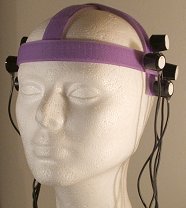
The 8 Coil Shakti is based on the Koren Helmet (The God Helmet), a technology that has been studied in many laboratory experiments. It’s also appeared several times in television documentaries about near-death experiences, alien abductions, and altered-states of consciousness. Art Bell has discussed it on his national radio show, and it has been given the nickname “The God Helmet”. It was the first generation of this technology, which was developed by Dr. Michael Persinger and Stan Koren of Laurentian University’s Neurosciences Department. The 8 Coil Shakti approximates the Koren helmet, but doesn’t duplicate it. A device that replicates the sessions used in the God Helmet experiments can be seen on this website.
The magnetic fields get stronger and weaker, duplicating patterns that appear in EEG traces. Although they’re still magnetic fields, they’re also ‘magnetic signals’, and that’s what we’ll be calling them.
There are two features you should understand:
It works by switching the magnetic fields between two sets of magnetic coils connected to the left and right channels of your sound card. This brings the areas within the magnetic fields to greater activity than stationary fields could ever achieve.
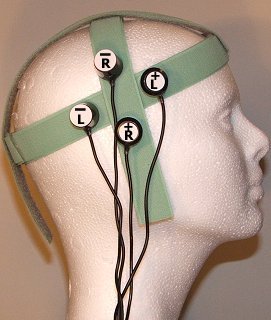
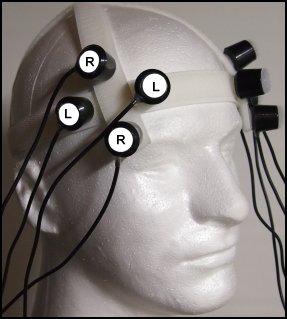
Each side of the head has two pairs of coils. When one of these pairs is producing the signals, the area under it becomes active, and it becomes quiet again when the other pair of coils is producing the signals. This alternation helps the brain to become active enough to produce a phenomenal experience – one that most people would call spiritual. The temporal lobes of the brain (as shown above) are the area most likely to produce spiritual experiences from this kind of stimulation, though the 8 Coil Shakti can be applied to several areas of the brain. To have such experiences using the 8 Coil Shakti, you will need to do your sessions during sensory deprivation, especially silence. Sessions done without silence can still have worthwhile effects, but silence can make them more “phenomenal”.
There are several ways of using Shakti that do not need sensory deprivation at all. If you use Shakti for mood enhancement, or meditation enhancement, there is no need for sensory deprivation.
Interestingly, laboratory studies have found that the effects are most pronounced during times of geomagnetic quiet (see current levels). The right conditions help Shakti work better, but you don’t need to do your sessions under perfect conditions in order for Shakti to work.
Shakti’s signals are irregular ‘bursts’ containing many frequencies.

Like Shakti Signals (Irregular bursts).

. Unlike Shakti Signals (simple frequencies).
This technology can enhance your meditation, yoga, or other spiritual practice when Shakti sessions are done so that they end about an hour before you begin. You don’t need sensory deprivation for this kind of Shakti session.
There is more to say about the 8 Coil Shakti, but the best way to fully understand what it can do is to read the rest of this page, and check out the online software demo, which is packed with information about how to use it, and what kind of effects each signal can produce, as well as how to set up your audio, where to put the coils and more. There are ‘quick start’ sessions as well as basic and advanced session designs.
Shakti uses audio files to play the signals. The ‘sounds’ have the same shape as an EEG signal – one whose appearance shows the activation of a particular structure (brain part). The magnetic coils are plugged into the sound card, just like a pair of speakers. When the audio file is played, the coils produce magnetic fields whose shape matches the shape of the original EEG trace.
When the signals are played and the coils are in place, the coils put out magnetic fields that match the original EEG trace. To use the 8 Coil Shakti effectively, you need to understand something about a few brain parts.
Let’s look at four of the sources for the signals: the amygdala, the hippocampus, the caudate nucleus, and the septum. You have two of each these, one on each side of the brain.
Shakti For Windows also has other signals based on different principles. These include the whole range of common frequencies (using the Function Generator included in the software), as well as some based on lab experiences and discoveries that don’t ‘target’ only one brain part.
__________________________
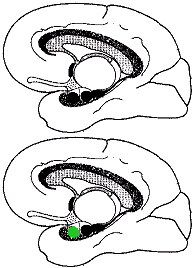
The AMYGDALA is an emotional structure.
On one side, it supports a broad range of positive emotions, such as elation, happiness, joy, and bliss (along with many other functions). It also functions to infuse our experiences with a sense of meaningfulness.
On the other side, it supports a broad range of negative emotions, most importantly fear, apprehension and sadness. In most cases, Shakti will not apply this signal to the right side of your head.
__________________________
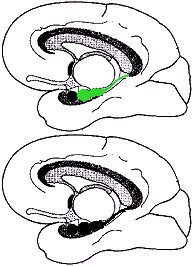
The HIPPOCAMPUS is a cognitive, or ‘thinking’ structure.
On the one side, it supports silent, non-verbal ways of thinking, positive thoughts and expectations, spatial perceptions, and several kinds of inner imaging, including imagination, visualization, and pictorial memories (along with many other functions).
On the other side, it supports verbal skills, negative thoughts and expectations, and logical thought (along with many other functions). This is based on previous work with the hippocampus using its signal.
__________________________
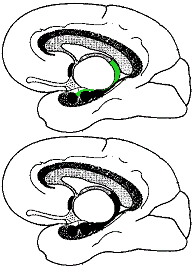
The CAUDATE NUCLEUS is a somatic or ‘bodily’ structure.
On one side, it seems to support arousal (including anger, excitement, sexual desire, and a sense of anticipation).
On the other, it supports relaxation, calm, and even lethargy.
Based on preliminary reports from people using this signal.
__________________________
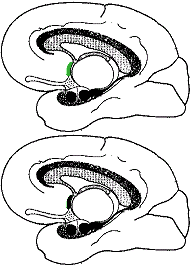
The SEPTUM is one of the brain’s “Pleasure Centers”. It’s one of the few brain parts most people have actually heard of.
It supports the experience of pleasure, with a special emphasis on sexual pleasure (including Orgasm)
Preliminary reports from a few people are consistent with its known role in mediating sexual enjoyment.
__________________________
Each of these structures has a signal that belongs only to it. The two signals appear on an EEG (An electroencephalograph. The signals that come out of these are also called ‘brain waves’.)
An EEG signal is a record of an electrical signal. Shakti begins when these EEG signals are converted into audio files that are ‘played’ into magnetic coils. The coils turn the audio output into magnetic signals.
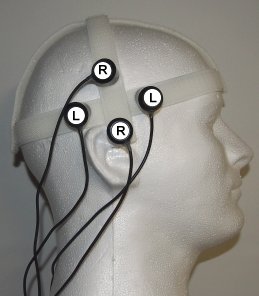 The magnetic signals are applied to the head at very low strength (close to what comes out of a telephone receiver when you’re holding it next to your ear). Many of the signals are short bursts, followed by intervals of silence. The low strength is used because experiments have shown they interact with the brain’s own electrical and magnetic activity.
Each signal speaks a language that only one brain structure understands.
So only the one brain part responds. It communicates with other parts, of course, and they, in turn, also start responding.
You have two of each of these structures – one on each side of the brain.
Shakti is applied using the structures own signal, but only over the side of the head where it supports something positive, or over both sides equally.
For the amygdala, it’s almost always on the left, and for the hippocampus, it’s almost always on the right.
For the septum and the caudate nucleus, its matter of personal preference which side is best.
When these structures respond, they put the person in a positive altered state of consciousness.
Even though we can apply the wave forms “symmetrically” (over both sides simultaneously), your brain probably doesn’t work symmetrically. For example, if you live with low self-esteem, you probably use your right side more.
If you’re prone to irritability, the left side of your brain might be more excitable. If you’re very emotional, your amygdala’s activity might offset your hippocampal activity a bit. If you think in pictures, you might have a busy right hippocampus. If you think in words, you might have a busier left hippocampus.
This means that some session designs may not be as effective as others for you.
The things that affect the way individual brains respond to Shakti often elate to long-standing, even lifetime, personality traits. If targeted structure has a history of low activity, the 8 Coil Shakti might produce quite a marked experience for that person.
These are not the only signals. There is one that tends to alter the “binding factor“ for human consciousness, based on years of lab work. This signal has produced some profound experiences.
There is also the recent addition of a signal derived from the Septum, the Brain’s “Pleasure center”. Initial reports indicate that its effects are consistent with the Septum’s function – the capacity for pleasure, especially sexual pleasure, though it has also produced reports or relaxation when used over the frontal lobes.
What you experience depends on who you are and how you choose to use Shakti.
If you want to try to have intense experiences, you do one-hour sessions, no more than one every three weeks. These sessions need sensory deprivation, including silence and darkness. You can do sessions every three days for 18 days (six sessions) and then stop for three weeks. Most people choose this way of using Shakti. (Safety note).
WHY ALTERNATE THE SIGNALS? – To make them move, eliciting more activity than stationary signals ever could.
Each pair of coils has two poles. One positive and one negative. (Note that some sessions designs use only positive coils).
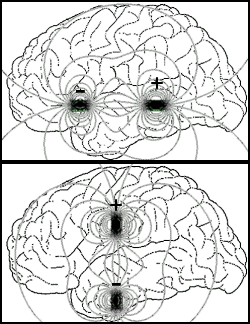
When the coils are actually producing the signals, the area between the coils are stimulated. Activity outside these areas is reduced. With the alternating signals, this happens too quickly for one of the two strips to finish deactivating before the other begins to activate. When positive coils are used together, they repel the fields deeper into the brain than when positive-and-negative coils are both used.
The activity created by one pair of coils is pulled into the area between the second pair of coils. This process, called ‘intrusion’, shunts the activity back and forth between the two strips of brain between the coils. As the two interact, the overall activity becomes much more intense than could ever be produced by stationary fields. Alternating signals over the temporal lobes are the ones that were used in most of the reports made famous through TV documentaries. Conversations with Persinger confirmed that alternating signals are equivalent to rotating coils in most respects.
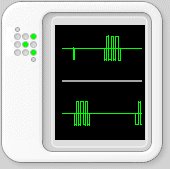
The top and bottom signals shown here represent the left and right stereo channels. The signal alternates between the two, activating two sets of magnetic coils. Each side of the head has coils from both channels.
There are some two-phase sessions that use one channel for the first phase, and the other channel for the second phase.
From a BBC report: (“God on the Brain” ):
“How does Dr. Persinger induce artificially religious experiences in his patients”?
“Dr. Persinger has designed a helmet that produces a very weak rotating magnetic field of between ten nanoteslas and one microtesla over the temporal lobes of the brain. This is placed on the subject’s head, and they are placed in a quiet chamber while blindfolded. So that there is no risk of ‘suggestion’, the only information that the subjects are given is that they are going in for a relaxation experiment. Neither the subject nor the experimenter carrying out the test has any idea of the true purpose of the experiment. In addition to this, the experiment is also run with the field switched both off and on. This procedure Dr. Persinger claims will induce an experience in over 80% of test subjects.”
From New Scientist (“In Search of God”)
“For several years, Persinger has been using a technique … to induce all sorts of surreal experiences in ordinary people. Through trial and error and a bit of educated guesswork, he’s found that a weak magnetic field–1 microtesla, which is roughly that generated by a computer monitor– rotating anticlockwise in a complex pattern about the temporal lobes will cause four out of five people to feel a spectral presence in the room with them.”
__________________________
The power of moving magnetic signals is illustrated in one study where 3 volunteers were given LSD and received sessions with moving magnets. When these were moving, the subjects saw “blobs of white, purplish, or greenish-yellow lights “. They didn’t see them when the magnets (ordinary horseshoe magnets) weren’t moving. And those were common magnets, not much different from the kind you might have on your refrigerator, like this: 
_____
Complete instructions are embedded in the software. Free Tech Support is Available.
_____
8 Coil Shakti – $285.00
Shipping – (USA) $12.50 (International) – $25.00.
_____
In the USA, you can order by calling (toll-free):
855-408-7888
By calling this number, you agree that you understand and agree to the terms of sale, listed HERE.
Read them before you order.
_____
Email Your Questions About The 8 Coil Shakti
Contact Us
_____
30 Day Money Back Guarantee.
Refund terms and conditions
_____
Legal: Templates for many signals are licensed for use with Shakti For Windows by Dr. M.A. Persinger and Stan Koren.
.
.
.
.
.
.
.
.