Main
________How
Shakti
Works________
Testimonials
________Lucid Dreaming
________Mood Enhancement
________Meditation Enhancement
________
The Feelgood Session
________Transformation with Shakti
________FAQs
________Mac
and
Linux
________Shakti & The God Helmet
________Schedule
For
Sessions
________For Professionals
________Credentials
________
Formal Description
________Safety
________
Add-Ons
NOTE: The Four-Coil Shakti is no longer available.
You can see the Eight-Coil Shakti here.
________
Contact Us
.
“OUR FRIEND, THE AMYGDALA”
Studies concerning the amygdala’s role in anxiety are perfectly valid, but there’s much more to the amygdala than that. The amygdala has hemispheric specializations – the left supports positive emotions, though the right does not.
The theories I work with primarily are those developed within the Laurentian University Behavioral Neurosciences Program, directed Dr. Michael A. Persinger.
One of the most important theories, and one which several published studies (as well as many Shakti reports) corroborate. It’s called the “interhemispheric intrusion hypothesis.” Reference (1) Reference (2)
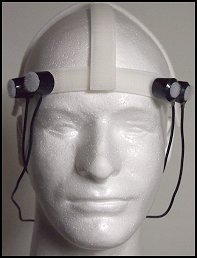
In brief, it says that many spiritual experiences can be explained as examples of a dramatic spillover from a structure on one side of the brain into the same structure on the other side. For example, intense activation of the amygdala on the right (fear) should happen in a life-threatening situation. If the threat actually manifests, and the person dies, they may begin an often-blissful experience that may be later recalled as a near-death experience (should they be resuscitated later on). First, intense fear, then bliss. Jesus faced Satan the desert. The Buddha confronted the Demons of Mara under the Bodhi tree. Ramakrishna lay comatose for days. Each of these preceded the epiphany that saw them become the holy men their traditions now recall.
The neural model for this process heavily emphasizes the very different emotional tones for the left and right amygdalas. (the correct plural is amygdalae, but let’s not get too formal). The ‘hellish’ experience is replaced by a ‘heavenly’ one as activation in the fearful amygdala crosses a threshold, shunting dominance over to the positive one.
There are two ways that the left amygdala might be activated during fear which is dominated by the right amygdala. One is the active suppression of positive emotions during moments of negative ones, which would require activation of the left. Suppressing left amygdala emotions will require activity there, even though it may not direct the emotional state.
The other is a process referred to as ‘intercalation’. This refers to the process whereby a left-hemispheric function (for example) recruits right-hemispheric pathways (‘matrices of neurons’) to fill in its operations. Thus, for example, language, on the left, requires non-verbal information processing, derived from the right. Words have both definitions and connotations, and the latter involves non-verbal cognition. When the same thing happens during moments of fear, the left amygdala will be activated as well as the right.
These arguments are all in principle. There is hard evidence. For humans, there is evidence from Persinger’s labs. There is also some significant data from rat studies that demonstrates that if you stimulate two of the amygdala nuclei in particular, the one on the right generated fear, and the one on the left reduced it. Other nuclei, regardless of side, reduced anxiety. Reference. From the abstract:
“Kindling of the left medial or left basolateral amygdala was anxiolytic (anxiety-reducing); right medial or right or right basolateral kindling tended to be anxiogenic (anxiety-provoking). Kindling of other than the medial or basolateral amygdala tended to be anxiolytic regardless of hemisphere”.
But people are not rats. Later in this note, we will look at the evidence from humans derived from stimulation of the amygdala using complex magnetic signals.
Another posting, offered as evidence that amygdala stimulation is dangerous reported a study that found enlarged amygdalas on both sides in patients with depression. The supposition is that if both amygdalas are enlarged in depression, then depression must have the same impact on each of them. This is not sound reasoning.
Increased amygdala volume means only that both amygdala must work harder in depression. The amygdala is a emotional structure, so it’s not surprising that both would differ in a depressed person. However, the activation of the left amygdala, specialized for positive emotions, may involve their inhibition. It takes a lot to suppress positive emotions (or any other for that matter).
Also, Vectorial Hemisphericity ( an important theory in Persinger’s work) states that no function is ever totally supported by only one side of the brain. Rather, hemispheric specializations are ‘vectoral’, involving both sides of the brain to different extents. The degree of difference between the contribution of each hemisphere for any given neural function depends on both the function in question, and the neural history of the person.
It would seem that depression does not de-activate the left amygdala, but rather changes the type of activity so that left-amygdala (positive) emotions are suppressed instead of enabled. It has been said that the brain works (and evolved by) starting with a function, then inhibiting it, then inhibiting the inhibition, and then inhibiting the inhibitory inhibitions of the inhibited inhibition. (I’m not trying to be difficult – it’s partly a joke – but only partly). Not doing something can take a great deal of neural activity at times.
Although depression impacts on both amygdalas (left and right), other studies have found marked and implicative differences between hemispheric function in depressives. The left frontal lobes are less active in people with depression. Right hemisphericity has been found to correlate with low-self esteem, a feature of most depression.
In fact, two studies have found that “Burstx” (which provided the template for the amygdala signal provided with the Shakti) can be effective in reducing depression (and anxiety). Reference1 Reference2 While complex magnetic signal technology may need more trials before it offers a treatment for depression, the results to date are more than sufficient to reply to the notion that there are inherent dangers in amygdala stimulation are not well-founded. Some people (left-handers, for example) should use care with it, and not everyone is equally sensitive to it. More to the point, the kind of positive emotions that left amygdala elicit are not equally fulfilling for each person. It may be too soon to generalize, but I’m getting the impression from the Shakti reports (using only the hippocampal or the amygdala signal, and both by default) that each person is likely to find one or the other signal more fulfilling. Shakti reports most often described phenomena that “clustered” around one signal or the other.
Another point raised online recently is that the amygdala is capable of learning long-lasting response to threats, a phenomenon that appears in PTSD. While this is true, it’s only half the story. The other side is one that doesn’t find its way into medical journals. The permanent elevation of self-esteem following positive events. Now, the best that life has to offer is not as good as the worst. The imperative for self-preservation isn’t matched by an imperative to feel good about oneself.
To follow up on this adequately, I must digress a bit.
One of the challenges I’ve faced over the last couple of years is to describe the range of emotions governed by the left amygdala. In principle, it should be the opposite of fear, and it is. But to see this, we need to recall that we are a social and hierarchical species, as well as being linguistic. Some of the best things in life are what anthropologists call “social rewards”. Like… money, sex, security, and power. Tenure. Primate studies have revealed that the amygdala is involved in social rewards. Two primate studies Reference1 “…these results suggest that the contribution of the amygdala is to provide the affective value of specific reinforcers (In this case, food) as accessed by associated conditioned stimuli. Reference2 “A number of recent studies now indicate that the amygdala is involved in a specific class of stimulus-reward associations…”
Since the pre-Hellenistic period, we’ve had a really cool social reward. Cash. Money magazine ran an article that reported a study that found that the amygdala responds to financial loss. The sudden acquisition of money, like a new job with better pay, can elicit a sense of well-being that meditation just can’t create.
The sense that “everything’s going to be all right” is one that can happen both in a near-death experience on meeting God, or when (if it happens to you) you find a briefcase filled with cash in small, unmarked bills.
Years ago, I was in a grocery store when a very old woman walked up to me, and in the thickest Russian accent I’d heard up to then said to me: “You are zo chandsome. You should be in Chollyvood” (ch as in ‘chutzpa’). Now, more than twenty years later, I still feel good remembering that. Believing oneself to be good-looking implies mating opportunities. Higher-ranking males have more mating opportunities than lower ranking males in most primate species (bonobo monkeys being a notable exception). To think that one will have an easy time finding mates is very close to thinking that one is an alpha male or female. Some will be offended by the idea that attractiveness is enough to make one an alpha individual, but Monika Lewinski and Pamela Lee each have offered proof that mating is enough to give women at least one kind of importance. The Sultan of Brunei (with his harem of over 20 women) is also a primate (Blessings of Allah be upon him and the good people of Burunei).
Just as a trauma can initiate lasting anxiety, a positive event can initiate lasting feelings of emotional pleasure. Has anyone ever read “Death of a Salesman”? The main character, recalling events decades before, says “I knocked ’em dead in Cincinnati.” All reason for pride gone, he remembers how he sold the goods years ago. Such a salesman simply must be an alpha. A man worthy of respect. One might coin a phrase : PPRS. Post-Promotion Relaxation Syndrome – a left-amygdala opposite to PTSD. But such a syndrome would not be a disorder, so no doctor will ever need to cure it. And nobody is going to fund research into it.
Sudden, abrupt activation of the left amygdala can produce lasting alterations in its functions. If you don’t believe me, just win the lottery, and then see how many fewer threats to your well-being you notice. A lump of cash is a social reward, and that means the amygdala. PTSD is more than just as right-hemispheric mirror of winning in life; it’s a pathology – a disease. One that affects the victims of modern warfare far more often than “normals”. I wonder if PTSD might not be possible because the modern threats to one’s life that war and terrorism offer go far past the threats that out brains are evolved to handle. Our evolutionary history just never offered us the chance to ‘get used’ to the kind of war we now see. If this is so, then we will never see a disorder that demonstrates ‘positive’ PTSD-like symptoms. The lasting threat of death is extremely stressful, but the lasting improvement in self-esteem that appears after an increase in one’s social rank will never be as powerful.
But can left-amygdala stimulation cause PTSD? NO. No way. How can I be so sure, you might ask? It’s been tested, though only with one pilot subject. Perhaps some an online forum readers will remember D. When he was participating in an online forum, he was working for the institute for human self-improvement in Sarajevo. His work with psychological disorders stopped when he was elected to the Croatian parliament. I’m sure we all wish him luck. I plan to ask him to re-sub in for a while, so that he can re-state his experiences, but members of parliament often have little time for our sort of nonsense.
I would encourage anyone who is interested in this to look at his an online forum posting (4/4/2001, msg. 13201) where he reported his experiences applying the hippocampal signal to the right and the amygdala signal to the left. His pilot had a session, and Plecko wrote that his subject, diagnosed with PTSD, reported that “The obsessive flow of thoughts became controllable.”
We should not leap to the conclusion that the Shakti Helmet is a treatment for PTSD after only one pilot subject. What it does show is that left amygdala stimulation does not worsen PTSD and did not even elicit an episode in one who had PTSD. The idea that left amygdala stimulation can create PTSD is just dead wrong.
Another misapprehension about the amygdala arises from one author who reported an article in an online forum that described a study that found that amygdala activation was suppressed and activity in the cerebellum increased during orgasm, a result with which I have nothing to debate. However, there have been unjustified conclusions drawn from this, which I should address because they relate to Shakti, and Shakti For Windows. Shakti For Windows can be applied to both the cerebellum and the amygdala.
The article, titled “No room for fear during sex” is accurate, but the researchers did not find that fear was deactivated during orgasm. They found that amygdala was de-activated, which would inhibit not only fear, but also the range of positive emotions supported by the left amygdala; elation for example. Sure, nobody’s in fear when they’re having an orgasm, but nobody’s ever happy. Another point about this study is that it doesn’t even address orgasm at all. Rather, it discusses ejaculation in males. But let’s let that pass. We can also let pass the many studies showing an amygdala contribution to the process of sexual arousal and orgasm.
‘No fear with orgasm’, but also no happiness. Rather, it’s a state of pleasure. And pleasure and positive affect are not the same thing. Just because a structure is de-activated during pleasure does not make it a pain center. I’ve always thought it odd that humans pursue pleasure with such vigor that they make happiness hard to achieve. Pleasure ends after a short interval (an orgasm can last only a few seconds, though some can train themselves to extend its duration). A good mood can last for days.
And have you ever thought to wonder why the facial expressions of extreme pleasure look so much like those of extreme pain? And that neither look anything like those of happiness? Nobody is in fear when having an orgasm, but nobody smiles, either.
Here’s the reasoning, as I understand it (remember, this is implied, not stated explicitly) The cerebellum is active and the amygdala is inactive during orgasm. Orgasm feels good. Therefore, amygdala activity must feel bad. This is not sound reasoning.
It’s also possible that another structure(s) is (are) modulating both, and that it’s not the cerebellum that’s muting amygdala activity, at all. Other structures might have their fingers on both buttons, so to speak.
Shakti For Windows can be applied to the cerebellum and to stimulate the amygdala, so people can find out for themselves to what extent these two types of stimulation cancel each other out. Of course, if anyone is uncomfortable with using the amygdala signal, they can still use the other ten (number will increase as the software is developed further).
One online posting claimed that switching off the amygdala will increase cognitive skills. It offered a link to a report that autism involves a dysfunction in the anterior portion of the temporal lobes. However, on reading the article, one finds no mention of the amygdala at all.
While the amygdala is extensively connected to the temporal lobes, to assume that a disorder of the temporal lobes (which autism appears to be to some researchers) automatically means that the amygdala(s) is compromised is not sound reasoning. I would not be surprised at all if the amygdala were dampened in autism, given that autism often includes cognitive skills that 1) outstrip ‘normals’ and 2) most commonly involve spatial pattern perception. These involve areas of the brain outside the amygdala in the limbic system, and the temporal lobes for the surface of the brain. As pattern perception is an instance of contextualization, and contextualization is a hippocampal operation, the hippocampus may be offering a surfeit of activity. As some Shakti participants (That’s the helmet, not the software) can attest, activating the hippocampus can inhibit amygdala phenomena. This has been tested with a few corrective sessions.
There have been two online postings that mentioned the activation of the left amygdala during moments of fear, and their author interprets this as laying to rest ” ‘certain’ theories of the amygdala”, as well as notions of the lateralization of function for the amygdala. The same author is outspokenly opposed to Persinger’s ideas, even though they have the support of scores of published studies.
Dr. Persinger has two published papers, and a sea of observations that support the statement that stimulation of the left amygdala can be very pleasant for many individuals, and may offer a treatment for depression and anxiety disorders. These statements are made regarding procedures that were carried out using hardware and software created by Persinger & Koren, which are not identical to Shakti. I spoke with Persinger on the phone recently, and he re-affirmed that ‘burstx’ (from which Shakti’s amygdala signal is derived) continues to elicit positive experiences and reports when applied over the left.
There are more points I could cover, but I believe I’ve made my point – the many warnings about the amygdala, and its stimulation are not well-founded, and although the amygdala signal should be used with care, it can be used safely. Hundreds of people have experienced this technology, and their reports, as well as a number of peer-reviewed publications, support the contention that amygdala stimulation using Shakti, Shakti For Windows, or Persinger’s apparatus can be used to good effect if used with care, and if the user takes advantage of the tech support.
Those interested in Shakti For Windows should note that there are almost a dozen other signals, a huge number, in fact – if one uses the function generator, as well as the specifically neural signals.
(NOTE: no statements about Shakti, Shakti For Windows, or Persinger’s apparatus have been evaluated by the FDA. These are not claimed to diagnose, prevent, or treat medical or psychiatric disorders.)
_________ NOTE: The Four-Coil Shakti is no longer available. You can see the Eight-Coil Shakti here.
. . . . . . .